
The textiles and fabrics industry depends on consistent and controlled heat throughout production. Processes such as dyeing, drying, heat-setting, coating, and finishing require stable temperatures to maintain fabric quality and production efficiency. Temperature variation can lead to defects, inconsistent coloration, or material distortion.
Thermal Fluid Systems, Inc. provides industrial heating solutions that support these requirements through reliable thermal oil systems using heat transfer fluid technology. These systems supply controlled heat to textile equipment used in continuous production environments, helping maintain consistent thermal conditions across multiple stages of fabric processing.
Heat Transfer Fluid Systems for Textile Production
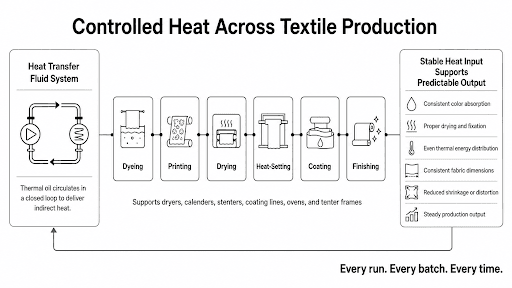
Textile manufacturing depends on steady heat delivery across large equipment and long production lines. A heat transfer fluid system circulates thermal oil in a closed loop, delivering indirect heat to processing equipment such as dryers, calenders, stenters, and coating lines.
Thermal Fluid Systems, Inc. provides heating systems that are built for continuous operation, where stable temperature control is required over extended production cycles. In textile applications, this supports consistent fabric treatment, reduces thermal variation across machines, and helps maintain production output without interruptions caused by temperature instability.
These systems are commonly applied where uniform heating directly impacts fabric finish, texture, and performance.
Dyeing, Printing, and Finishing Applications
Dyeing and finishing lines rely on controlled heat to achieve consistent fabric results. Thermal Fluid Systems, Inc. supports these operations with equipment that delivers steady heat through a circulating heat transfer fluid loop.
In dyeing processes, controlled temperature helps maintain consistent color absorption across fabric batches. In finishing and coating lines, stable heat supports proper curing and surface treatment without affecting fabric structure. Printing operations also benefit from controlled thermal input that supports drying and fixation of inks and coatings.
The focus is straightforward: stable heat input leads to predictable output, batch after batch.
Drying and Heat-Setting Processes
Drying and heat-setting are key stages in textile production, especially for synthetic materials such as polyester and nylon. These processes require controlled heat to remove moisture and lock in fiber structure.
Thermal Fluid Systems, Inc. provides heating systems that distribute thermal energy evenly through dryers, ovens, and tenter frames using heat transfer fluid circulation. This helps maintain consistent fabric dimensions and reduces the risk of shrinkage or distortion during production.
For operations running continuous lines, this type of heat control supports steady output without frequent adjustments to equipment settings.
Flanged Immersion Heaters in Thermal Fluid Systems
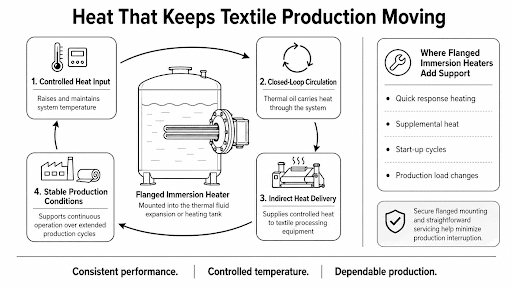
Within thermal fluid heating packages, flanged immersion heaters play a direct role in generating heat for the system. These electric heaters are mounted into the thermal fluid expansion or heating tank and provide controlled heat input to raise and maintain system temperature.
Thermal Fluid Systems, Inc. integrates flanged immersion heaters into its designs where quick response heating or supplemental heat is required. In textile operations, this becomes useful for maintaining production during load changes or supporting start-up cycles.
The flanged design allows secure mounting and straightforward servicing, which helps keep heating systems operating with minimal interruption during production schedules.
Heat That Keeps Production Moving, Not Guessing
Ready to bring tighter temperature control into your textile operations? Connect with Thermal Fluid Systems, Inc. and get a heating solution built around consistent performance, efficient heat transfer fluid systems, and dependable flanged immersion heaters.
Let’s get your process running at the right temperature—every run, every batch, every time.